Our Story
In 2022, a few years before the Northeast Occultation Network (NEON) program existed, the Westport Astronomical Society (WAS) provided members with access to the Westport Observatory telescope to pursue their astronomy interests. NEON co-founder Dr. Kevin Green, a physicist at the University of New Haven, was conducting and analyzing asteroid occultations at the time and trained high schooler Monica Charmoy in this as well. This initiated the feature of accessible, hands-on astronomy that is one of the best parts of NEON.
In 2023, WAS member Serena Diamond, NEON’s other co-founder, joined their efforts. Mentored by Dr. Green, Serena learned to record and analyze occultations and became deeply invested in the team’s work. The team worked together for some time collecting occultation data and submitting the data to NASA’s JPL.
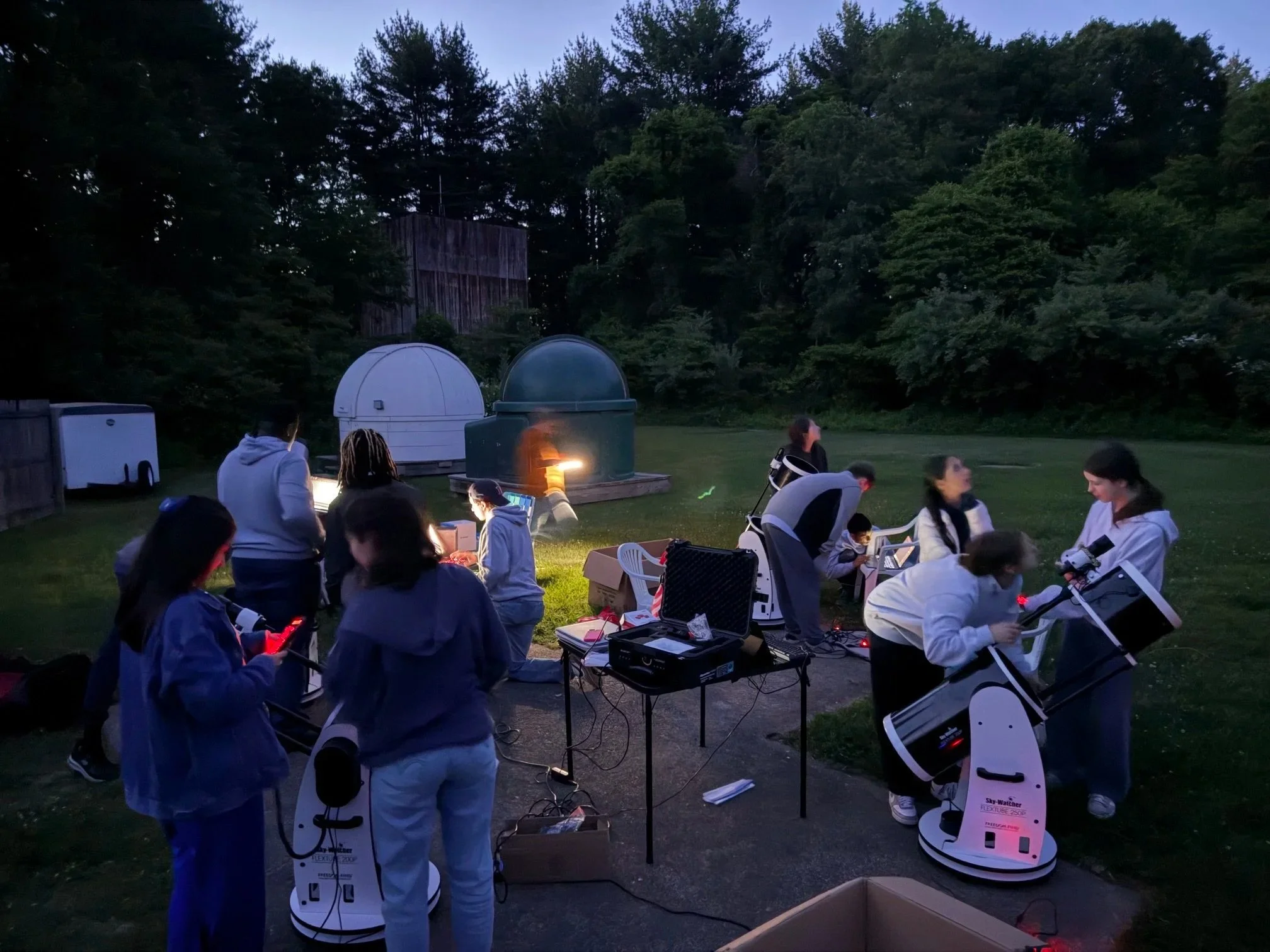
They began bringing in and training more individuals. As the group grew, they recognized that taking optimal data required recording from multiple locations simultaneously, something they couldn’t do from a single observatory location. To expand their scientific reach, the growing group began observing from multiple locations at once, including the University of New Haven and the John J. McCarthy Observatory.
When Monica eventually left for university, the momentum didn’t stop. The desire to continue gathering and submitting asteroid data increased, taking Dr. Green and Serena as far away as Indiana and Illinois chasing asteroid shadows in pursuit of compelling events.
It was around this time that Serena and Dr. Green were thinking of ways to raise much needed operational and equipment funds for WAS, a gem in the community of Westport that makes astronomy accessible and was the initial source of telescopes and computers necessary to do the work. Serena was recognizing how important mentorship was becoming in her pathway toward her dreams of making discoveries in astrophysics, and Dr. Green had a particular gift for connecting with students and making research fun. Above all, in order to create meaningful asteroid data, they knew that fully utilizing multiple sets of datapoints and recordings from differing areas would necessitate a larger team.
Soon afterwards, NEON was born. Dr. Green and Serena came together to plan curriculum, form the program’s marketing and enrollment process, gather students, and engage other graduate students Dr. Green had been doing occultation research with. They brought on additional teaching assistants, including Ashley Oluwasegun, Sangeeta Kuchibotla, and Sel Chen, who had experience researching with the team. They formed a structure for rolling out the opportunity to develop students into researchers. The first few cohorts were successful, and now the world has an increasing number of new scientists as NEON continues.
The development of NEON has been a triumph in three major ways: raising funds to support the purchase and maintenance of the asteroid occultation research facilities, exposing and training future scientists in the world of astronomy, and growing our research and data capture capabilities in order to make a more material contribution to science.